The CI HUB Connector for Canva offers a range of features designed to enhance your workflow. These features focus on improving file management, providing deeper insights into assets, and optimizing the user experience.
1. Enhanced File Filtering and Compatibility
The CI HUB Connector filters out unsupported files, displaying only those compatible with Canva. An always-visible info tooltip informs users that unsupported formats are filtered out, providing clarity and helping make asset management faster and more intuitive.

2. Smarter Asset Browsing and Search
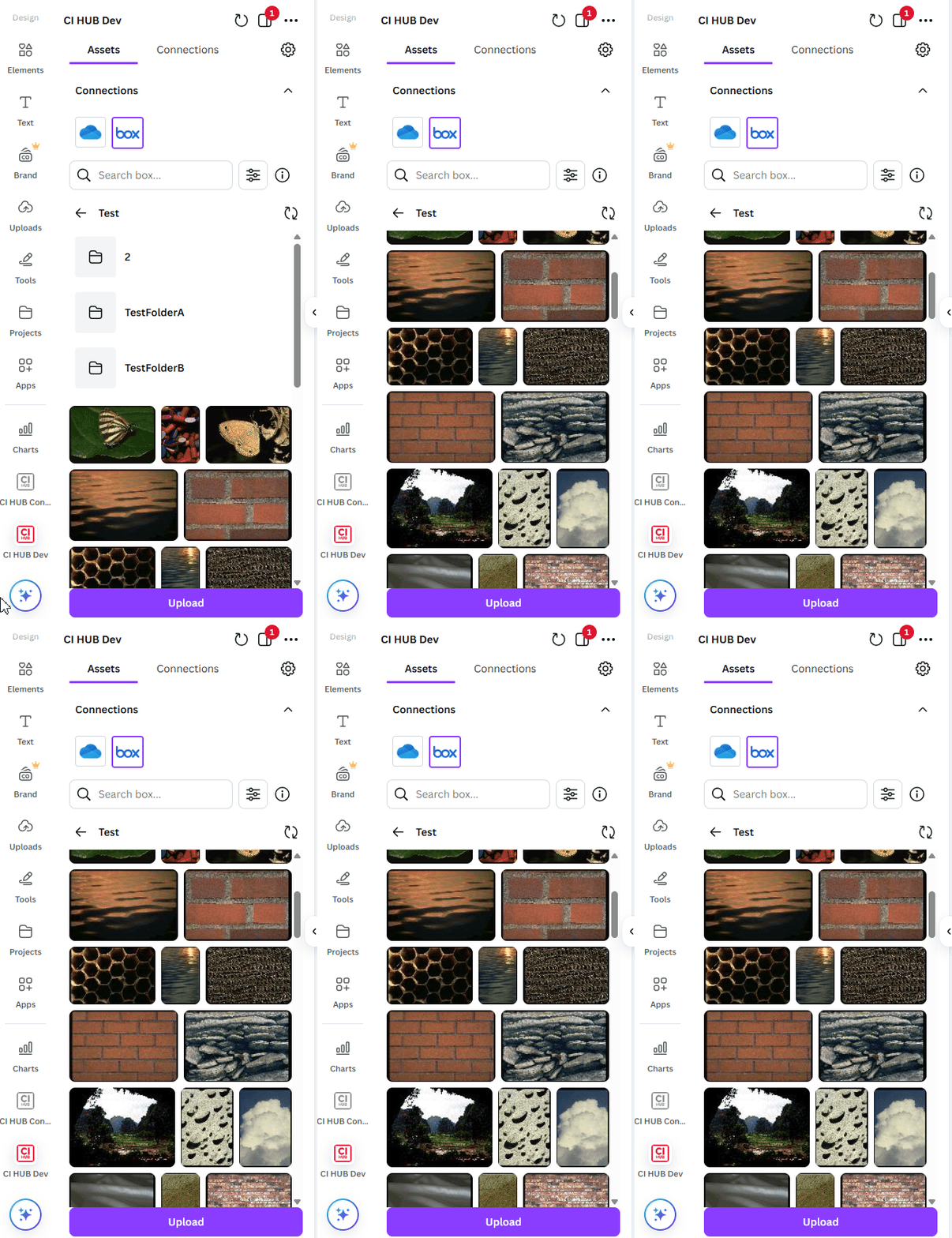
Easily navigate and locate your assets with enhanced browsing and filtering tools. As you scroll through the asset list, more files will load automatically, if available, making navigation seamless.
To support better visibility, file names in the grid view are displayed in a tooltip on hover, reducing clutter while keeping full file names accessible.
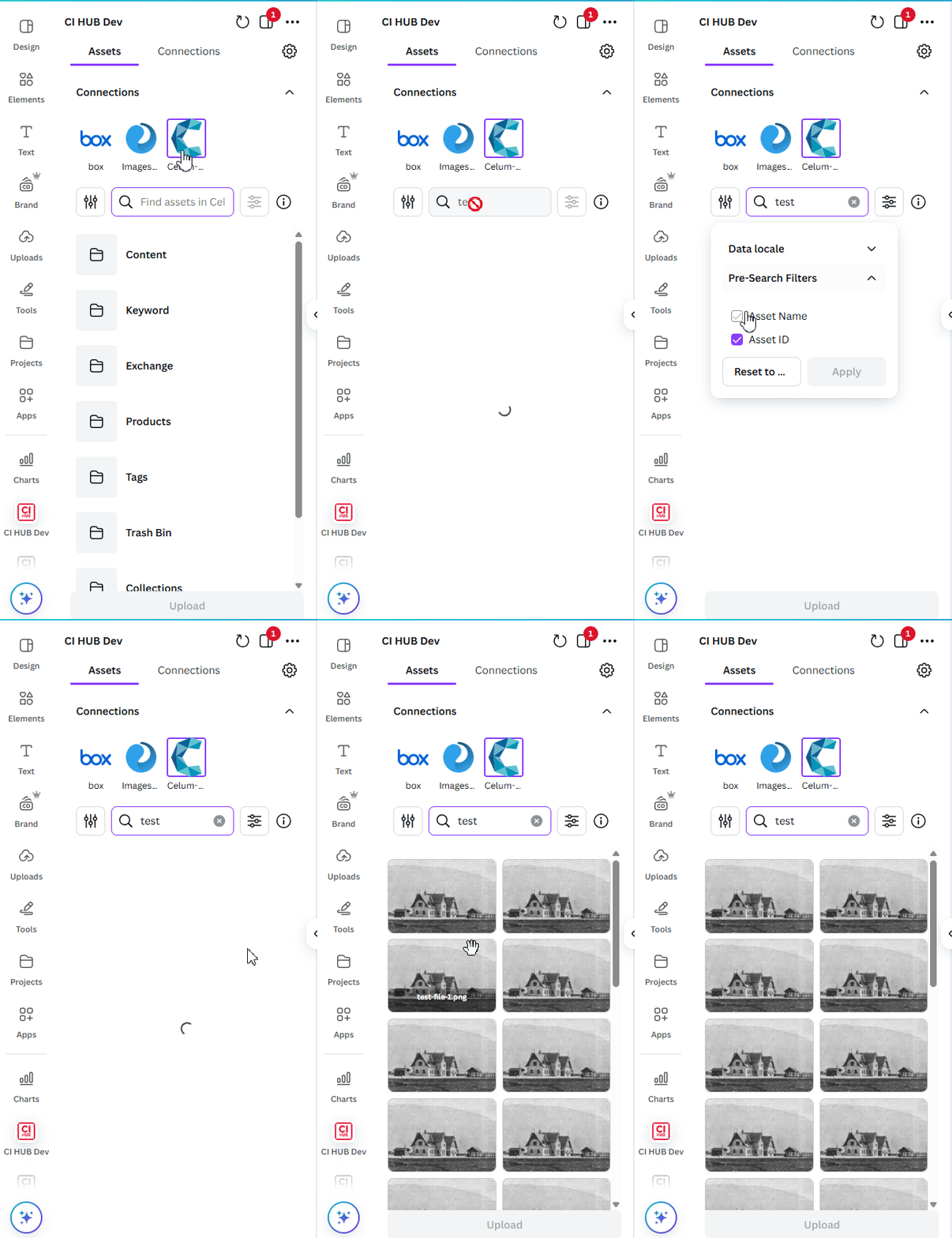
Additionally, the Filter Feature beside the search bar helps you narrow results by parameters such as last modified date, image date taken, image dimensions, and more. Filter options vary depending on the connected source. If no filters are available, the filter icon will appear disabled.
For some connections, you can also use the Pre-Search Filter, which lets you refine results before the search executes. Simply type your keyword, press Enter, and the pre-search filter will apply to display only the most relevant results.
4. Detailed Asset View with Metadata and Renditions
The asset details view offers a comprehensive look at your files, along with a seamless rendition management feature that lets you browse and switch between different renditions of an asset. Once you’ve selected the rendition you want, simply click Add the selected rendition to design to add it directly to your Canva design.
You can also open the asset in your DAM, PIM, or cloud storage system for further exploration whenever needed. In addition, you’ll find a rich metadata section that brings everything together, showing essential details like file type, size, dimensions, and creation date, plus any custom metadata from the connected system. From there, you can even drag and drop asset metadata directly into your Canva design to enrich your creative work with accurate information.
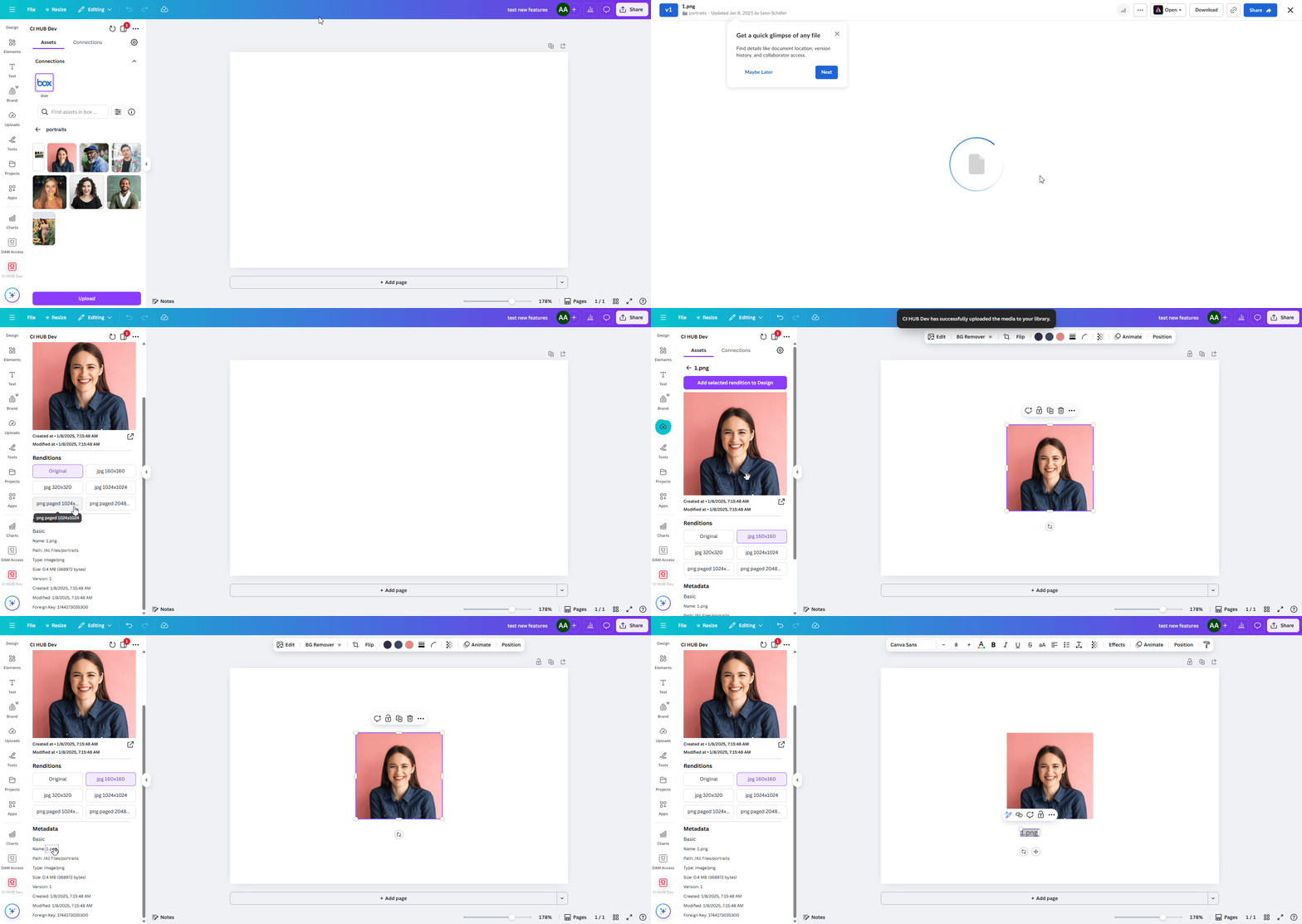
To ensure a smooth creative workflow, the connector automatically checks Canva’s supported file formats. If an original file type isn’t supported in Canva, but a compatible rendition (such as PNG, JPG, SVG, MP4, or PDF page exports) is available, you can still use the asset in your design. In these cases, the connector inserts the best available compatible rendition automatically, and assets that work this way are clearly indicated so you know what will be added to your design.
When browsing folders, you may also see files that Canva doesn’t currently support. These appear in a de-emphasized state so you know they exist and can still access their metadata, even if they can’t be inserted into a design. This helps prevent confusion caused by empty or partially populated folders and gives you full visibility of your DAM, PIM, or cloud storage system content.
These enhancements make it simple to evaluate assets, access detailed insights, and find the perfect fit for your creative needs, all without leaving the platform.

5. Streamlined Upload Feature
This feature allows users to upload files directly from their Canva designs or their local system into their preferred DAM, PIM, or cloud storage system, automatically placing them in the currently open folder. Multiple files can be uploaded at the same time from both sources.
During the upload process, all selected files are displayed in a list, giving users the opportunity to review and manage them. Users can remove any file they no longer wish to upload.
For files prepared in Canva, once the file is ready and displayed in the UI, the file name field is editable. By default, the file name is the one provided by Canva. Users can modify the file name before uploading; However, the file type/extension cannot be changed. When the user clicks Upload, the file is uploaded using the edited file name.

6. User Account
The CI HUB Connector for Canva provides users with easy access to all account and license information. Users can view their account details, as well as their current license type and expiration date.
When a license is approaching expiration, a reminder message will appear, showing how many days are left and prompting the user to renew.
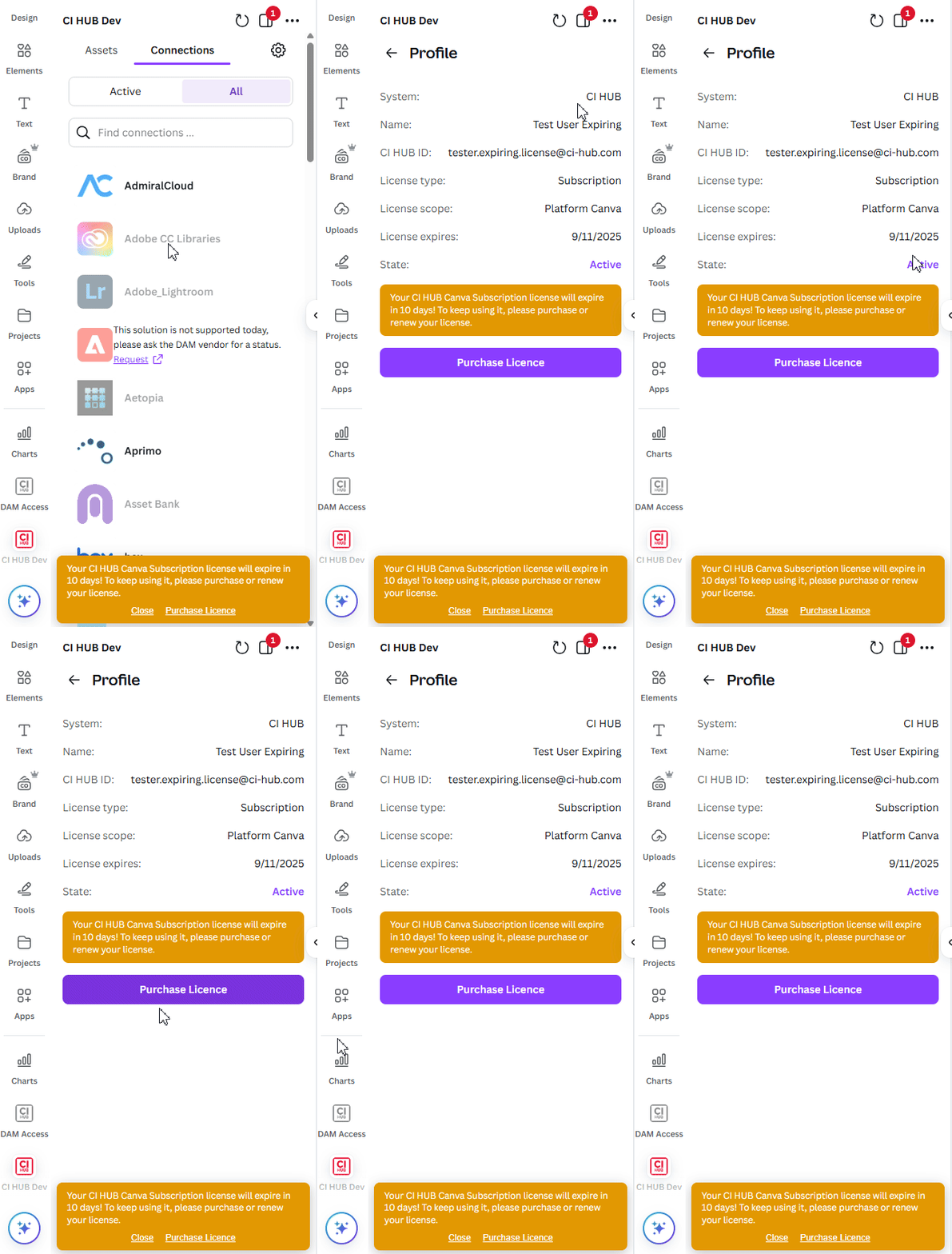
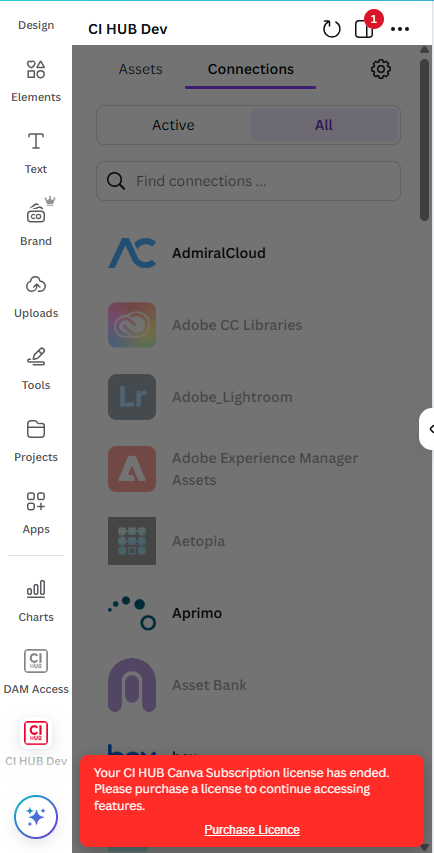
If a license has expired, the connector will display a clear message indicating that the license has expired and that a new purchase is required to continue using the connector.
To make renewal or purchase simple, a Purchase License button is available, allowing users to buy or upgrade their license directly from the connector.